One Water Honolulu: One Water Honolulu is a collaborative, climate resilience initiative focused on creating sustainable and integrated water management systems across O’ahu. By treating rainwater, stormwater, drinking water, and wastewater as one connected resource, the initiative supports smarter infrastructure planning, water conservation, and long-term environmental stewardship. Through federal funding support, interagency collaboration, and coordinated policy and design efforts among eight City and County of Honolulu agencies, One Water Honolulu advances resilient infrastructure projects, prioritizes community needs, and strengthens Oahu’s ability to address challenges such as sea level rise, drought, and extreme weather.
Hawai'i One Water: Hawai’i One Water is a collaborative initiative focused on strengthening how water is managed across the state by bringing together counties, agencies, organizations, and communities under a shared vision. Through coordinated governance, aligned funding, and place-based solutions, Hawai’i One Water supports integrated water management that protects the state’s water resources while meeting the needs of communities, ecosystems, and future generations.
Wai'anae Readiness Review: The Waiʻanae Readiness Review project aims to build long-term resilience for the Waiʻanae community by identifying risks from natural hazards and establishing a strong foundation for future adaptation projects. Two committees will be created to help inform the process and outcomes. The project team will conduct a comprehensive climate risk assessment by modeling climate hazards such as wildfire and coastal flooding with physical assets to identify hotspots where community-essential infrastructure and services are most susceptible to disruption. Based on these identified hotspots and in collaboration with the committees, the project will determine priority pilot projects that offer actionable recommendations to mitigate high-priority risks. These pilot projects will include basic design concepts, planning-level cost estimates, and approximate timelines to equip the community and other stakeholders with the necessary information to successfully pursue future implementation funding.
HIEFC (Hawaiian Islands Environmental Finance Center): The Hawaiian Islands Environmental Finance Center is a program operated by the Hawai’i Community Foundation (HCF). This program empowers local groups and government agencies with training and technical support to secure federal funding for water conservation, reuse, and recharge projects, while building a local water workforce. One World One Water (OWOW) brings experience working with both public and private sector partners and has been a trusted collaborator across multiple partnerships. In this effort, OWOW will partner with HIEFC to provide technical guidance and on-the-ground support as needed, while also engaging with community members to understand their goals and assess their readiness and capacity to move projects forward.
Desal Task Force: The Task Force, as requested by Senate Concurrent Resolution SCR54_HD1, is convened to evaluate the feasibility of large-scale desalination in Hawai’i as a strategy to diversify and secure the state’s potable water supply. Members include stakeholders from across the state with technical and industry expertise in water resource management.
CMSCWD (Carnelian-Marine-St. Croix Watershed District): One World One Water (OWOW) will provide time and materials to support Birchline Planning on this project. Focusing on developing and administering stakeholder/shoreline surveys, conducting interviews, and producing a summary report. Key tasks include facilitating board workshops to refine regulatory rules, and framework revisions, supplemented by full-year consultation and project administration.
Hawai'i Statewide Reuse Study - Stakeholder Engagement Workshops: Beginning in 2018, assisted the DOH in reuse policy development, nation-wide reuse regulatory review and stakeholder engagement efforts to forward Reuse projects throughout Hawai’i. Facilitated meetings with national reuse leaders, technical experts and local leaders to develop recommendations to integrate reuse into Hawaii’s water system, including funding, regulatory, legislative and public perception. Developed a stakeholder engagement survey to gain an updated understanding of stakeholder perception, barriers and opportunities for Reuse in Hawai’i in 2025. Interpreted Survey results that contributed to the scope of work for the five stakeholder engagement meetings designed, coordinated and facilitated these meetings with a diverse group of stakeholders at different locations across the state. The goal of these workshops is to build on the previous body of Reuse work, gather direct input from stakeholders in each County, and interpret the survey results from a wide group of stakeholders to inform the development of a RFP for the Statewide Reuse Study led by the Commission on Water Resource Management.
Cesspool Conversion Working Group Facilitation and Planning: Assisted the Hawaii Department of Health in organizing a cross-sector working group and developing a long-range comprehensive plan for the conversion of statewide cesspools by 2050. Project work included planning and facilitating main and subgroup meetings from 2018-2022 that included finance, technology, data and approach for prioritizing cesspools. Developed request for proposals, managed sub-contractors, provided meeting summaries in accordance with Hawaii’s Sunshine Law, and drafted the Cesspool Conversion Working Group 2050 Plan. The Cesspool Conversion Working Group 2050 Plan outlines strategies required to transition to septic or sewer systems, including a phased implementation financing approach, policy alignment and community support.
BWS One Water Watershed Management Plan Guidance: Assisted with the development of Honolulu’s Watershed Management Plans. Researched the opportunity to implement a collaborative, integrated ‘One Water’ approach to water management in Hawaii and developed a narrative to include in the WMPs. Researched existing and potential stormwater recharge areas for Oahu and outlined potential programs and policies to incentivize stormwater retention on the island. Researched and compiled reuse project opportunities for Oahu through surveys and discussions with stakeholders. Both the reuse and stormwater research and recommendations will be incorporated in Honolulu’s WMPs.
Freshwater Blueprint: Conservation, Reuse and Recharge: Assisted Hawaii Community Foundation in the implementation of Hawaii’s Freshwater Blueprint to create 100mgd in additional, reliable fresh water capacity for Hawaii by 2030. This project included interviews with water stakeholders in Hawaii, research into water savings in conservation, reuse, and recharge, a rate study of stormwater fees, and participation at national water conferences.
Freshwater Blueprint: Water Reuse Task Force Facilitation: Helped Hawaii Community Foundation and the Hawaii Department of Health organize a Water Reuse Task Force to bring together key stakeholders and discuss how to scale water reuse in Hawaii. Collaborated with water reuse expert, Dr. Bahman Sheikh, to share the current status of water reuse in Hawaii along with innovations and strategies from other states. The Task Force resulted in a report to legislature, a list of recommendations for the State, and ideas for potential demonstration projects.
Freshwater Security Estimations: Calculated approximate water savings for various reuse, recharge, and conservation water policies for the State of Hawaii. Developed mgd estimations with resources for policies in reuse, recharge, and conservation.
Water Security Grant Administration: Assisted Commission on Water Resources Management in administering an innovative statewide water security grant in the amount of $600,000. Facilitated water security advisory group meetings and assisted in grant program design which resulted in eleven new projects funded in water reuse, recharge and conservation.
Hawai'i Drought Plan Update: Revised the 2005 drought plan to include the impacts of climate change on Hawaii’s fresh water security along with updates to drought mitigation and response actions. Completed a revised 2017 Hawaii Drought Plan, published by the Commission on Water Resources Management. This revised plan will help improve coordination and implementation of drought management strategies for the State of Hawaii.
Facilitation for Kohala Water Study: Provided facilitation services for the Kohala Water Study Public Information Meeting. This included providing meeting logistics, meeting facilitation, preparing and designing meeting formats and handouts, and note taking.
Maui Water Utility Management: Management of small rural water utilities including GIS asset management, planning, capital improvement planning and implementation, budgeting, operations management, regulatory compliance, customer relations and oversight of metering & billing. Creation of asset management maps, cap-x planning, water audits, energy study and daily operator logs.
Oahu Environment Modeling: Identification of the appropriate model to trace a land-based environmental pollutant from the coastline to the ocean. Tasks included GIS data gathering, mapping, preparation of model data input for land based environmental pollutant modeling.
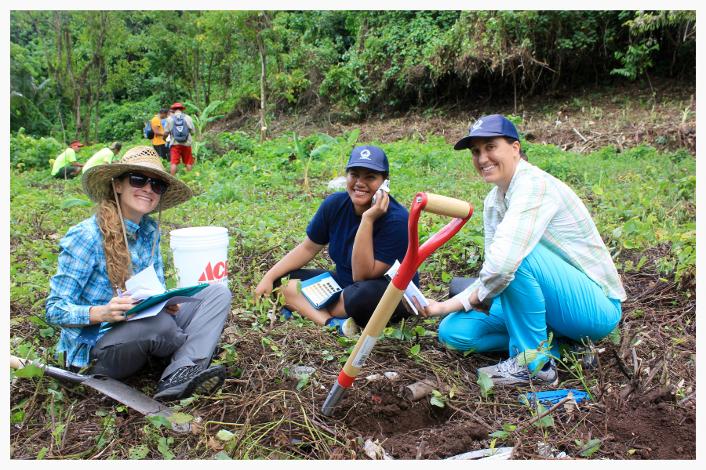
American Samoa Wetland Delineation and Determination Project: Trained American Samoa Coastal Management staff the steps of wetland identification and mapping. This included GPS and GIS trainings along with hands-on botany, soil, and hydrology identification methods, GPS training and in-field delineation trainings.
Training on Drinking Water Regulations: Preparation materials, planning training logistics and ultimately training American Samoa water utility staff on new rules and regulations related to safe drinking water under EPA Contract. Training completed, over 20 participants with 4 CEUs.
American Samoa Marine Web Portal Design: Consolidation of marine policies into GIS data layers production of those layers onto a web map/ data portal. GIS training for on-site staff, and trained individuals marine web map.
American Samoa Coastal and Watershed Mapping: This project translated community knowledge and stories into datasets that can be used for resource management. The scope of this project included support in planning, facilitation in community meetings, GIS mapping and production of maps and digital products to display uses as well as support action planning with the community.